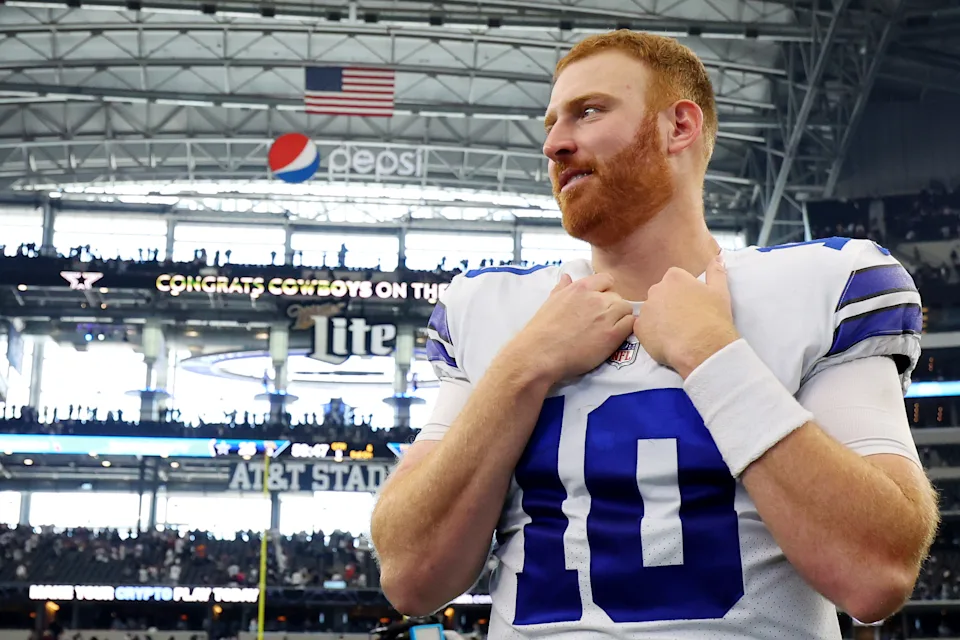

Cooper Rush has built the kind of NFL career that rarely arrives with a dramatic entrance. Instead, it has been shaped by patience, preparation, and the ability to remain ready when opportunity suddenly appears. From an overlooked high-school prospect to a productive college quarterback and an undrafted NFL player, Rush has repeatedly occupied the space between expectation and possibility. His story is therefore about more than statistics. It is about the culture of professional football, where careers are often determined not only by talent, but also by resilience, timing, trust, and the willingness to wait for a moment that may never come.
The Early Years of a Quarterback Who Was Easy to Overlook
Long before the NFL spotlight, Cooper Rush was already learning what it meant to exceed modest expectations. At Lansing Catholic High School in Michigan, he developed into a prolific passer and helped establish himself as one of the state’s notable high-school quarterbacks. Yet his recruiting story was surprisingly quiet: Central Michigan was his only scholarship offer. Rather than treating that limited opportunity as a judgment on his potential, Rush accepted it and turned the decision into the foundation of his professional career. That early experience became a recurring theme: opportunity mattered most when he was prepared to seize it.
Cooper Rush and the Making of a Central Michigan Leader
At Central Michigan, Rush quickly transformed from an overlooked recruit into one of the program’s most accomplished quarterbacks. He took over as a starter early in his college career after an injury created an opening, and he remained remarkably durable while developing his command of the offense. By the end of his collegiate career, he had accumulated 12,894 passing yards and 90 touchdown passes, while also earning recognition for his academic performance and leadership. His college journey showed that his greatest asset was not simply arm strength; it was the combination of preparation, intelligence, consistency, and composure.
From Undrafted Prospect to the Dallas Cowboys
The 2017 NFL Draft offered Rush another test of patience. His name was not called, but the disappointment lasted only briefly because the Dallas Cowboys signed him as an undrafted free agent shortly after the draft. For many players, going undrafted can feel like a verdict. For Rush, it became another beginning. He impressed during training camp and earned a place on Dallas’s roster, eventually becoming the team’s backup quarterback. That transition was significant because it demonstrated something scouts had already noticed at Central Michigan: his football intelligence and disciplined approach could compensate for the lack of draft-day attention.
Why the Backup Quarterback Role Matters
The backup quarterback occupies an unusual position in professional sports. He may spend weeks preparing with the same intensity as a starter while receiving almost no public attention. Then, without warning, he can become the most important player on the field. Cooper Rush became familiar with that contradiction during his Dallas years. His job required constant preparation without any guarantee of playing time. Consequently, his value was measured not simply by game statistics, but by his readiness to understand the offense, communicate with teammates, and step into difficult circumstances. In that sense, his career reflects the invisible labor behind professional football.
The Moments That Changed His Reputation
Rush’s reputation grew whenever circumstances pushed him from the sideline into meaningful action. His 2021 season was particularly important, as he started a game for Dallas and produced 422 passing yards across five appearances, including three touchdown passes. The following year, his responsibilities expanded again, and he appeared in nine games with five starts, throwing for 1,051 yards and five touchdowns. These numbers did not transform him into a franchise quarterback, but they established something equally valuable: credibility. Rush showed that a team could place responsibility in his hands without abandoning its identity or structure.
A Career Built on Preparation Rather Than Hype
There is a broader cultural fascination with athletes who succeed without arriving as obvious stars. Football often celebrates first-round selections, record-breaking prospects, and players surrounded by enormous expectations. Rush represents the other side of that narrative. His career has developed through incremental victories: making a roster, learning an offense, earning trust, waiting behind established quarterbacks, and responding when circumstances changed. Moreover, his path illustrates how professional sport rewards a particular form of patience. Not every successful player becomes a superstar, and not every meaningful career needs to follow a conventional trajectory.
Cooper Rush in Numbers: A Career Snapshot
| Career detail | Cooper Rush |
|---|---|
| Position | Quarterback |
| College | Central Michigan |
| NFL entry | 2017, undrafted free agent |
| First NFL team | Dallas Cowboys |
| NFL teams through 2025 | Dallas Cowboys, Baltimore Ravens |
| Career passing yards through 2025 | 3,766 |
| Career passing touchdowns through 2025 | 20 |
| Career appearances through 2025 | 42 |
| Career starts through 2025 | 16 |
NFL statistics underline the unusual shape of Rush’s career. Through the 2025 season, he had appeared in 42 games and made 16 starts, completing 364 of 596 passes for 3,766 yards, with 20 touchdowns and 14 interceptions. His 2024 Dallas season was his largest workload, when he played 12 games, made eight starts, and threw for 1,844 yards and 12 touchdowns. The numbers reveal a player whose career has been defined by opportunities arriving intermittently rather than through uninterrupted starting responsibility.
The Move Beyond Dallas
After years associated with the Cowboys, Rush’s professional journey entered another chapter with the Baltimore Ravens in 2025. His Ravens statistics were modest, with four appearances and two starts, producing 303 passing yards without a touchdown and four interceptions. Nevertheless, the significance of the move extended beyond one statistical line. Changing organizations requires learning a different system, adapting to new coaches and teammates, and rebuilding professional relationships. For a veteran quarterback, that process can be particularly revealing because experience becomes valuable when it helps a player adapt quickly rather than simply repeat what worked somewhere else.
The Quiet Importance of Being Ready
One of the most compelling elements of Rush’s story is the psychology of readiness. A player who does not know when he will be called upon must prepare without the emotional reward of certainty. Every practice becomes an audition, even when nobody is formally watching. Furthermore, backup quarterbacks must maintain confidence without allowing frustration to dominate their thinking. That balance can be difficult. Rush’s longevity suggests an ability to navigate it. His career is a reminder that professional excellence is sometimes measured in preparation for moments that arrive unexpectedly, rather than in the number of moments a player receives.
Why His Story Resonates Beyond Football
Rush’s journey connects with a wider cultural idea about success: not everyone receives an obvious invitation to greatness. Some people begin with one opportunity, an uncertain route, or a position that appears secondary. What matters is what happens next. His story therefore resonates beyond football because it reflects a familiar human experience. A person can be overlooked without being incapable, and a delayed opportunity can still become a meaningful one. In an era fascinated by instant visibility, Rush offers a quieter alternative built around endurance, professionalism, and the belief that preparation retains value even when recognition comes late.
The Broader Lesson of an Undrafted Career
Being undrafted is not merely a footnote in Rush’s biography; it provides context for the entire arc of his career. Central Michigan’s own account of his transition to Dallas emphasized how he turned disappointment into an opportunity and earned a roster position through training-camp performance. That progression matters because it demonstrates how careers are constructed after the headlines disappear. The draft may determine a player’s starting point, but it does not necessarily determine his staying power. Rush’s experience shows that the professional game continues to evaluate players long after draft weekend has ended.
Cooper Rush and the Value of Football Intelligence
Rush has frequently been associated with cerebral preparation, a characteristic that was already visible during his college career. Central Michigan described him as intelligent, academically accomplished, and deeply knowledgeable about the game. Those qualities are especially relevant to quarterbacks because the position requires processing information quickly while maintaining communication and control. Physical ability may open the door, but understanding defensive structures, recognizing pressure, managing protections, and making decisions under stress can determine whether a quarterback remains useful. Rush’s longevity offers an example of how intellectual discipline can become a durable professional asset.
The Human Story Behind the Statistics
Statistics can explain what happened on the field, but they cannot completely describe what it feels like to spend years preparing for opportunities that may last only a few games. That is where Rush’s story becomes more human. His career has involved uncertainty, competition, movement, and repeated adaptation. Yet there is also something reassuring in that pattern. He did not need a perfect path to build a legitimate NFL career. Instead, he needed enough persistence to remain available when circumstances changed. For fans, that makes his journey less about celebrity and more about professional character.
What Comes Next for Cooper Rush
The next chapter of Rush’s career will inevitably depend on circumstances that are difficult to predict. Quarterback opportunities can change rapidly because of injuries, roster decisions, trades, coaching philosophies, and performance. However, his history suggests that uncertainty is hardly unfamiliar territory. Whether he remains a veteran reserve, competes for a larger role, or eventually moves toward the later stages of his playing career, his professional identity has already been established. He is a quarterback who repeatedly found ways to remain relevant after expectations had moved elsewhere.
Conclusion: A Different Definition of Success
Cooper Rush’s career offers a useful counterpoint to the mythology of instant success. He was lightly recruited, went undrafted, entered the NFL without the protection of draft status, and spent years working behind more established quarterbacks. Yet he kept finding ways to stay in the conversation. His story is ultimately about patience transformed into opportunity. More importantly, it demonstrates that success in professional sports does not always require becoming the face of a franchise. Sometimes it means earning trust, staying prepared, responding when called upon, and building a career that lasts longer than anyone initially expected. That may be a quieter achievement, but it is an achievement nonetheless.