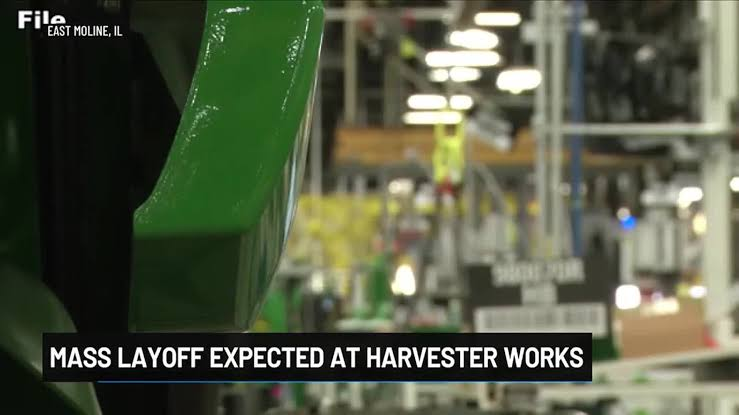

John Deere layoffs 2025 became one of the clearest signs that the machinery giant was navigating a difficult turn in the agricultural cycle. For workers in Iowa and Illinois, the story was not simply about corporate cost-cutting; it was about uncertainty spreading through communities whose identities have long been tied to manufacturing, farming, and the steady rhythm of industrial employment.
The layoffs unfolded against a broader slowdown in farm-equipment demand. Deere had already begun reducing its workforce during 2024, when lower crop prices, high equipment costs, and weaker farmer purchasing power affected orders. Reuters reported that the company was cutting production and salaried positions as it attempted to align costs with declining demand.
A Difficult Start to 2025
The first weeks of 2025 brought the consequences of that slowdown into sharper focus. On January 3, 80 workers at Deere’s Davenport Works lost their jobs, followed by 112 employees at Waterloo Works on January 6. Another 75 positions at the Ottumwa facility were scheduled to disappear in February. Local reporting said the company attributed the reductions to low demand and challenging market conditions.
Those numbers may appear modest beside the size of a multinational manufacturer, yet their meaning is larger in the communities involved. A factory job supports more than one household. It can sustain local restaurants, retailers, contractors, schools, housing markets, and service businesses. Consequently, a workforce reduction can ripple outward long after the factory gates become quieter.
The Numbers Behind the Workforce Reductions
The pattern continued beyond January. In February, Deere announced that 119 employees at its Des Moines Works facility in Ankeny would be laid off in several groups, with the reductions scheduled for March and April. The company pointed to lower customer orders and expectations for weaker row-crop cash receipts.
Later in the year, additional reductions appeared in Iowa. WARN data compiled from official notices recorded layoffs at Ankeny, Waterloo, and other facilities. By September, another 71 Waterloo workers were affected, while a further 101 were scheduled for layoffs in October.
| Location | 2025 layoffs reported | Context |
|---|---|---|
| Waterloo, Iowa | 284 | Multiple rounds involving production-related operations |
| Ankeny, Iowa | 159 | Reductions announced in several groups |
| Ottumwa, Iowa | 75 | Connected to weaker demand and production changes |
| Davenport, Iowa | 80 | Reduction effective in January |
These figures should be read as documented individual WARN notices rather than a single companywide announcement. Moreover, some notices filed in late 2024 became effective during 2025, which explains why reporting about the year’s reductions can differ depending on whether researchers count announcement dates or effective dates.
Why Farmers Bought Fewer Machines
At the heart of the story was the economics of farming. Modern tractors, combines, harvesters, and construction machines represent enormous investments, so farmers are particularly sensitive to commodity prices, interest rates, financing conditions, and expectations for future income. When those variables become uncertain, replacing an existing machine can quickly move from necessity to postponable expense.
Deere’s own financial results illustrate the pressure. In fiscal 2024, worldwide sales and revenues fell 16%, while net income declined from $10.166 billion in 2023 to $7.1 billion. For fiscal 2025, Deere subsequently reported net income of $5.027 billion, with full-year sales and revenues down 12%.
Therefore, the workforce reductions were not occurring in isolation. They reflected a larger adjustment after an extraordinary period for agricultural machinery. Record farm economics earlier in the decade had encouraged strong equipment purchases; once that momentum faded, manufacturers faced the difficult task of matching production with a more cautious customer base.
The Human Cost of an Industrial Adjustment
For affected workers, corporate language such as “demand,” “inventory,” and “operational efficiency” can feel distant from everyday reality. A layoff notice, however, is intensely personal. It can mean reconsidering a mortgage, delaying a family purchase, searching for another skilled job, or wondering whether a community that once offered dependable industrial careers will provide the same opportunities in the future.
That emotional dimension matters because manufacturing has a particular cultural importance in the American Midwest. Generations of workers have built careers around factories where technical knowledge is passed from one employee to another. Consequently, workforce reductions can feel like more than temporary economic events; they can challenge assumptions about stability, identity, and what a good industrial career looks like.
From Factory Floor to Smart Machine
There is another layer to the story: John Deere is simultaneously transforming what its machines represent. In January 2025, the company showcased autonomous equipment at CES, highlighting computer vision, artificial intelligence, and advanced cameras designed to allow machines to perform increasingly complex tasks. Deere said the technology could help customers dealing with shortages of skilled labor.
That creates an intriguing tension. Farmers may need more technology because finding workers is difficult, while manufacturers are also redesigning their own operations around productivity, automation, and digital systems. The future factory is therefore not necessarily a smaller factory in every sense; it may be a factory where fewer people perform more technologically sophisticated work.
For employees, that transition raises important questions about training. Traditional machining, welding, assembly, and maintenance skills remain valuable, but increasingly they intersect with software, sensors, robotics, data, and automated production systems. The industrial worker of tomorrow may need a broader technical vocabulary than the worker of yesterday.
A Company Cutting Costs While Still Investing
It would be misleading, however, to describe the 2025 reductions as evidence that Deere was simply retreating from American manufacturing. The company’s financial and investment strategy presented a more complicated picture. Deere continued to describe advanced manufacturing, technology, and long-term U.S. investment as central to its future.
The contrast became especially visible in 2025 and 2026. Deere continued developing new equipment and technology while later announcing plans for additional U.S. facilities. The company says its broader American manufacturing strategy includes major investments and thousands of jobs over time.
This suggests a significant distinction between reducing employment in response to short-term demand and abandoning manufacturing altogether. Companies can simultaneously close or reduce certain production capacity while investing heavily in newer facilities, products, and technologies. For workers, though, that distinction offers little comfort if their particular plant or position is affected.
What the Layoffs Say About Rural America
The wider significance of John Deere layoffs 2025 lies in the relationship between agricultural prosperity and industrial employment. Farm machinery companies depend on farmers, but communities surrounding those manufacturers depend on the factories themselves. When agricultural income weakens, the consequences can travel backward through the supply chain and outward through local economies.
This interconnectedness helps explain why Deere’s workforce decisions receive attention far beyond corporate earnings reports. A tractor is not simply a machine; it sits at the intersection of farming, manufacturing, finance, technology, transportation, and rural culture. When fewer tractors are ordered, the effect can eventually be felt by the people who build them as well as those who operate them.
The Meaning of Resilience
Yet the 2025 story was not exclusively one of decline. Deere’s financial results showed that the company remained profitable despite difficult conditions, while its strategy continued to emphasize technology, productivity, and long-term investment. In 2026, the company began recalling workers at several Iowa facilities as demand improved in parts of its business. Deere announced that 146 employees would return across four Waterloo operations, while nearly 100 others were recalled at Davenport and Dubuque facilities.
Those recalls offer an important reminder: manufacturing employment can move with the business cycle. A layoff does not always represent the permanent disappearance of an industrial skill or community. Nevertheless, repeated reductions can leave workers and families reluctant to assume that yesterday’s employment model will return unchanged.
What Comes Next for John Deere Workers?
The future will likely depend on several forces moving together: crop prices, farmer income, interest rates, global trade, equipment inventories, technological adoption, and demand for different categories of machinery. Deere itself entered fiscal 2026 expecting continued pressure in large agricultural equipment while seeing better prospects in smaller agriculture, turf, and construction and forestry.
For workers, the most important question is therefore not simply whether another round of layoffs will occur. It is whether the next phase of industrial growth creates stable, skilled positions that allow communities to rebuild confidence. That means investment must be measured not only in buildings and machines, but also in training, career pathways, and opportunities for workers whose experience represents a substantial part of America’s manufacturing heritage.
Conclusion: More Than a Layoff Story
John Deere layoffs 2025 were ultimately part of a much larger economic narrative. They reflected the difficult adjustment taking place after a powerful period of agricultural equipment demand, while also revealing how closely rural communities remain connected to global markets and corporate decisions.
At the same time, the company’s continued investment in automation, advanced machinery, and U.S. manufacturing suggests that the industrial story is changing rather than simply ending. The factory of the future may look different, and the skills required inside it may evolve considerably. However, behind every production target and financial forecast are people whose livelihoods depend on the machinery moving down those factory lines.
That is why the significance of these layoffs extends beyond the numbers. They offer a window into an American economy trying to balance efficiency with stability, technological progress with human experience, and short-term uncertainty with long-term industrial ambition. For the communities built around John Deere, that balance will ultimately be measured not in spreadsheets, but in whether families can continue to see manufacturing as a viable future.