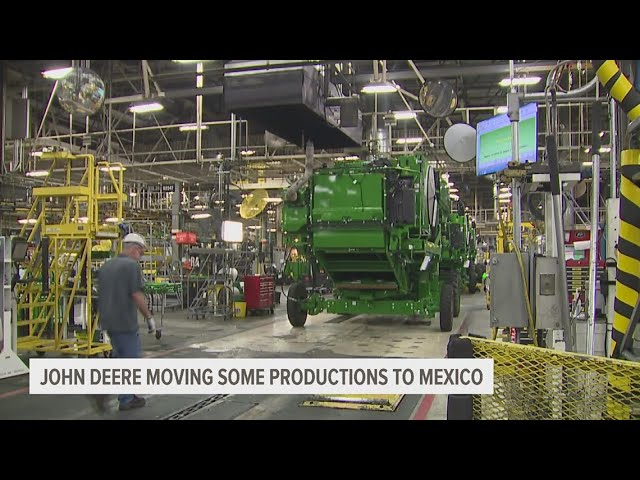

John Deere moving to Mexico has become a symbol of a much larger debate about the future of American manufacturing. The agricultural-equipment giant has not announced that its entire U.S. manufacturing operation is relocating south of the border. Instead, Deere has been shifting selected production to Mexican facilities while restructuring several U.S. plants. In 2022, the company announced plans to move tractor-cab production from Waterloo, Iowa, to Ramos, Mexico. In 2024, it announced another planned transfer involving certain skid-steer and compact-track loaders from Dubuque, Iowa.
A Manufacturing Story Bigger Than One Company
The discussion surrounding John Deere moving to Mexico is ultimately about how multinational manufacturers balance jobs, costs, investment and long-term competitiveness. Deere says its decisions reflect changing business conditions, manufacturing costs, workforce availability and the need to make room for future products. At the same time, workers and communities often experience these decisions differently. For a factory town, a production line is not merely an industrial asset; it can represent wages, family stability, local spending and a sense of continuity built across generations.
What John Deere Is Actually Moving
The phrase John Deere moving to Mexico can make the situation sound broader than it is. Deere continues to manufacture substantial quantities of equipment in the United States, while Mexico has become an important part of its North American manufacturing network. In 2024, Deere announced plans for a new Ramos facility to produce mid-frame skid-steer loaders and compact track loaders, with production ramping down at Dubuque and transferring to Mexico by the end of 2026. Deere’s 2025 annual filing later confirmed that certain loader production had shifted to Mexico.
The Timeline Behind the Headlines
| Year | Development | Why It Matters |
|---|---|---|
| 2022 | Deere announced the transfer of tractor-cab production from Waterloo to Ramos, Mexico | The move was expected to affect about 250 positions |
| 2024 | Deere announced plans to shift selected loader production from Dubuque to Ramos | The new Mexican facility was planned to become operational in 2026 |
| 2024 | Hundreds of Midwest production workers faced layoffs | Deere cited weaker demand and changing factory requirements |
| 2025 | Deere reported that selected loader production had shifted to Mexico | The move became part of its broader manufacturing restructuring |
The timeline shows why the story cannot be reduced to a single announcement. Deere’s Mexican operations have existed for decades, and the company has repeatedly described Mexico as part of a broader manufacturing footprint rather than a wholesale replacement for U.S. production. Nevertheless, every individual transfer matters to the workers whose jobs are connected to those lines. The contrast between corporate strategy and community experience is what makes the story especially significant in America’s industrial heartland.
Why Mexico Has Become Part of the Strategy
Mexico offers manufacturers several advantages within a highly integrated North American production system. Labor availability, manufacturing costs, established industrial infrastructure and proximity to U.S. markets can all influence investment decisions. Moreover, companies operating across the continent can distribute different stages of production between facilities according to their capabilities. Deere already had manufacturing operations in Ramos, making the location more than an unfamiliar overseas experiment. In this context, the move reflects a broader transformation in how North American companies design supply chains and allocate factory capacity.
The Human Cost Behind a Corporate Decision
For workers in Iowa and Illinois, however, corporate efficiency can feel remarkably personal. In 2024, Deere announced layoffs affecting hundreds of production workers across Midwest facilities, while separately outlining its plans for loader production in Mexico. The company said changing market demand required adjustments to production levels and workforce needs. Yet behind those announcements were households planning around paychecks, benefits and uncertainty. A factory worker may see a production transfer not as an abstract optimization exercise, but as a question about mortgage payments, children’s education and whether a familiar career remains possible.
Deere’s Argument: Restructuring for the Future
From Deere’s perspective, the manufacturing changes are part of a larger effort to remain competitive while preparing American facilities for new products. The company has emphasized factory optimization, operational efficiency and the ability to use facilities in different parts of its global footprint. In the Waterloo case, Deere said moving cab production would help balance labor requirements and free manufacturing space for new products. That argument illustrates an important distinction: production relocation does not necessarily mean abandoning a U.S. factory altogether.
What Happens to the Communities Left Behind?
Industrial communities rarely measure economic health only through the number of jobs listed on a company payroll. Manufacturing supports restaurants, suppliers, transportation firms, housing markets and countless smaller businesses. Consequently, a reduction in factory employment can have effects beyond the plant gates. At the same time, a large manufacturer can continue investing in a community while changing the type of work performed there. That makes the future of places such as Waterloo and Dubuque more complicated than a simple story of factories disappearing. The real question is what kind of manufacturing work remains.
Mexico Is Not Simply the Villain
It is tempting to frame the debate as American jobs versus Mexican jobs, but that interpretation overlooks the workers on both sides of the border. Mexico’s manufacturing sector employs people whose livelihoods also depend on multinational investment. For those workers, a new production line can represent opportunity, professional advancement and economic security. Therefore, the deeper issue is not whether Mexican workers should receive manufacturing jobs. Instead, it is whether trade rules, corporate strategies and labor policies create a system in which workers everywhere can share in the value they help produce.
The Role of Trade and Tariffs
The economics of the strategy have also become more complicated. Deere’s 2025 annual filing acknowledged that relocating manufacturing can create tariff exposure and reputational risks. It specifically noted that products whose production shifted to Mexico became subject to additional U.S. tariffs in 2025, while Deere pursued potential treatment under the United States-Mexico-Canada Agreement. This illustrates how a decision designed to improve manufacturing efficiency can encounter new costs elsewhere. Global production is therefore not simply a race toward the lowest labor cost; it is a balancing act involving trade policy, logistics and market access.
Why the Story Resonates So Strongly in America
The emotional response to John Deere moving to Mexico is partly rooted in what the brand represents. Deere is more than an equipment manufacturer in the American imagination; its green-and-yellow machinery is deeply associated with farming, rural communities and industrial craftsmanship. The company was founded in 1837, and its manufacturing history has become intertwined with the development of the Midwest. Consequently, changes inside Deere’s factories can feel like changes in the cultural landscape itself. When a production line moves, communities naturally ask whether an important piece of their industrial identity is moving with it.
A More Complicated Future for American Manufacturing
The lesson from Deere is not that American manufacturing is disappearing, nor that Mexico is inevitably replacing the United States. Instead, manufacturing is becoming more specialized, interconnected and geographically distributed. Some traditional assembly work may move to lower-cost locations, while U.S. plants concentrate on advanced equipment, engineering, technology and higher-value production. Deere itself has continued to manufacture major products in the United States while expanding its Mexican capabilities. The future will therefore depend on whether American communities can attract investment in the next generation of manufacturing rather than simply preserve every existing production line.
What John Deere Moving to Mexico Ultimately Means
John Deere moving to Mexico is best understood not as one dramatic departure, but as a case study in the difficult choices facing modern industrial companies. Deere is reorganizing production across North America while responding to demand, labor conditions, manufacturing costs and changing technology. For shareholders, those decisions may represent efficiency. For workers, they can represent uncertainty. For Mexico, they can bring industrial opportunity. And for American manufacturing communities, they raise a more enduring question: how can the next generation of industrial prosperity be built when the geography of production is constantly changing?
Conclusion: The Factory Floor Is Still Part of the American Story
The debate surrounding John Deere moving to Mexico will continue because it touches something larger than corporate logistics. It asks what companies owe the communities that helped build them, what workers should expect from globalization and what manufacturing should look like in an era of increasingly sophisticated supply chains. Deere’s strategy demonstrates that industrial America is changing rather than simply disappearing. Ultimately, the challenge is to ensure that efficiency and global competitiveness do not come at the expense of human dignity, economic opportunity and the communities that have long stood beside the factory floor.