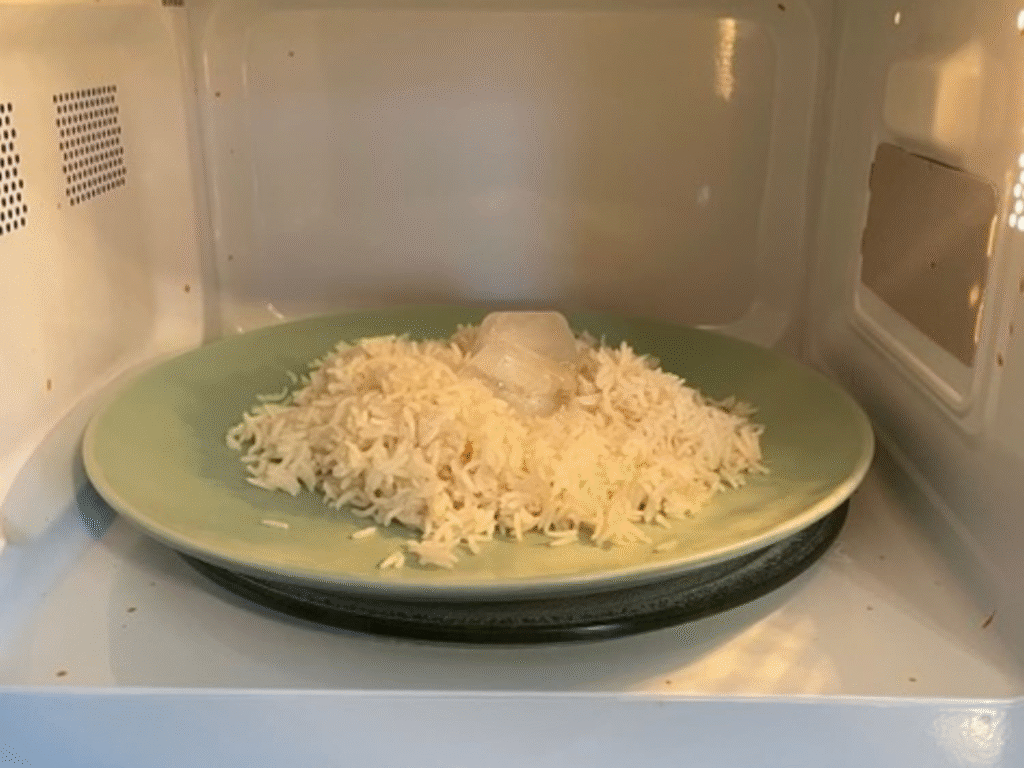

Can you reheat rice? Yes—but the real question is not whether cooked rice can survive a second encounter with heat. It is how that rice was handled between its first cooking and its second serving. Rice is one of the world’s great comfort foods, appearing in biryanis, pilafs, fried rice, rice bowls, curries, and countless family meals. Yet its humble appearance can disguise a genuine food-safety issue. When cooked rice is cooled and stored properly, reheating can be perfectly reasonable; when it sits warm for too long, however, the risks change.
Why Rice Deserves More Attention Than It Gets
Rice seems uncomplicated: boil, steam, serve, refrigerate, and warm again. However, uncooked rice can contain spores of Bacillus cereus, a bacterium associated with food poisoning. Cooking may destroy many ordinary bacteria, but these spores can survive. Consequently, the important moment is often not the reheating itself but what happens after the rice leaves the heat. If cooked rice remains at room temperature for too long, the spores can develop into bacteria and potentially produce toxins.
That distinction matters because reheated rice has developed an unfair reputation. People sometimes assume that putting yesterday’s rice in a microwave automatically makes it dangerous. In reality, the greater concern is poor storage. The Food Standards Agency explicitly explains that the problem is not reheating itself, but the way rice was stored beforehand. Therefore, a safe second serving begins long before the microwave, frying pan, or stovetop is switched on.
The Refrigerator Is Where the Real Story Begins
Once a meal is finished, timing becomes surprisingly important. Rather than leaving a large pot of rice on the counter to cool slowly, food-safety guidance recommends cooling cooked rice as quickly as possible, ideally within one hour, and then transferring it to the refrigerator. Dividing a large quantity into smaller portions or spreading it into a shallow container can help it cool faster. Afterward, it should remain covered and refrigerated until it is needed.
This is particularly relevant in homes where rice is prepared in generous quantities. A family might cook a pot for dinner, leave it in the kitchen while everyone eats, and return to it hours later. That habit can feel harmless because the rice still looks and smells normal. Nevertheless, appearance is not a reliable safety test. The longer cooked rice remains in conditions that allow bacterial growth, the greater the concern. In other words, convenience should begin with sensible storage, not with hope.
How Long Can Cooked Rice Stay in the Fridge?
There is an important difference between general leftover guidance and specific advice for rice. The U.S. Department of Agriculture generally recommends using cooked leftovers within three to four days, while the UK’s Food Standards Agency takes a more conservative approach specifically for cooked rice, advising that refrigerated rice be consumed within 24 hours.
For readers looking for a simple household rule, the stricter approach is easier to remember: cool rice quickly, refrigerate it promptly, and aim to eat it within a day. This is especially useful when preparing rice for lunch the following day. Moreover, labeling containers with the date can prevent the familiar refrigerator mystery in which several identical boxes quietly compete for attention. When there is genuine uncertainty about how long rice has been sitting out, throwing it away is the safer choice.
Reheating Without Turning Rice Into a Dry, Clumpy Dish
Safety and quality are closely connected, because good reheating should restore moisture without leaving cold patches. In a microwave, placing the rice in a suitable covered container and adding a small amount of water can help create steam. Stirring partway through is also useful because microwaves do not always heat food evenly. USDA guidance recommends covering and stirring or rotating food during microwave reheating, while also checking that it reaches a safe temperature throughout.
On the stovetop, a covered pan and a splash of water can revive refrigerated rice gradually. Low to medium heat is generally preferable to aggressive heating, because the goal is to warm the grains evenly rather than scorch their bottoms. Meanwhile, a wok or skillet can transform cold rice into fried rice, where yesterday’s grains become an advantage because they are often firmer and less sticky. Thus, reheating can be more than recovery; it can also be reinvention.
The One-Reheat Rule
One of the simplest pieces of advice is also among the most useful: reheat only the portion you intend to eat. Food Standards Agency guidance says cooked rice should not be reheated more than once and should be steaming hot throughout when reheated.
That means a large container should not repeatedly travel from refrigerator to table and back again. Instead, portion out what you need and leave the rest safely chilled. Once reheated, the rice should be eaten promptly. This approach also improves texture. Repeated heating and cooling can gradually turn fluffy grains into something dry, sticky, or unevenly warmed. So, the best practice is simultaneously safer and more appetizing: portion first, heat once, and serve.
A Familiar Food Across Cultures
Rice carries a cultural significance that makes this everyday question more interesting than it first appears. In South Asian kitchens, leftover rice may become fried rice, lemon rice, pulao, or another meal entirely. In East and Southeast Asian cuisines, day-old rice is frequently valued for dishes where firmer grains separate well during frying. Elsewhere, leftover rice can become the foundation for soups, puddings, croquettes, or quick weekday meals.
Consequently, the question of reheating rice is also a question about thrift and tradition. For generations, households have learned to stretch ingredients rather than discard them. Modern food-safety guidance does not reject that tradition; instead, it places boundaries around it. The cultural lesson is therefore not “never eat yesterday’s rice.” It is “respect yesterday’s rice enough to store it properly.”
When You Should Simply Throw It Away
There are moments when the most sensible kitchen decision is also the least sentimental. If cooked rice has been left at room temperature for an extended period, particularly in a warm environment, it is better not to gamble on its safety. Similarly, if you cannot remember when it was cooked or refrigerated, uncertainty itself becomes a reason to discard it.
USDA guidance notes that perishable food should generally not remain unrefrigerated for more than two hours, or more than one hour when temperatures exceed 90°F (32°C). Rice-specific guidance can be even more conservative, recommending rapid cooling within about an hour. The few spoonfuls saved are rarely worth risking an entire evening of illness.
A Practical Guide for Everyday Kitchens
| Situation | Sensible approach |
|---|---|
| Freshly cooked rice | Serve promptly or cool it quickly |
| Rice you want to save | Divide into smaller portions and refrigerate promptly |
| Refrigerated rice | Follow conservative rice-specific guidance and use within 24 hours |
| Reheating | Heat until steaming hot throughout |
| Microwave reheating | Cover and stir or rotate for more even heating |
| Multiple reheats | Avoid reheating the same rice more than once |
| Rice left out too long | When in doubt, discard it |
The details may vary slightly between national food-safety authorities, but the central principle remains remarkably consistent: time and temperature matter.
FAQs About Reheated Rice
Can you reheat rice in the microwave?
Yes. Microwave reheating is practical when the rice has been stored safely. Covering the container, adding a little moisture, and stirring during heating can help distribute heat more evenly. The finished rice should be steaming hot throughout.
Is reheated rice dangerous?
Not inherently. The principal risk comes from improper storage, particularly allowing cooked rice to remain at room temperature for too long. Bacillus cereus spores can survive cooking and may multiply when cooked rice is held under unsuitable conditions.
Can you reheat rice twice?
It is best not to. Food Standards Agency guidance recommends reheating cooked rice no more than once. Portioning leftovers before reheating makes following this advice much easier.
Can you eat rice cold?
Yes, provided it was cooled rapidly and stored correctly. Food Standards Agency guidance notes that rice can be eaten cold when it has been cooled quickly and kept refrigerated, with consumption within 24 hours.
The Question Is Simple; the Answer Is About Habits
Can you reheat rice? The answer is yes, but the safest answer comes with a qualification: reheating is only one part of the story. What matters more is the quiet sequence that happens afterward—how quickly the rice is cooled, how it is stored, how long it remains refrigerated, and whether it is reheated just once.
Ultimately, rice offers a small lesson in everyday food culture. It is economical, adaptable, deeply traditional, and wonderfully resistant to waste. Yet those virtues work best alongside basic kitchen discipline. Treat leftover rice as food that deserves the same care as any other perishable dish, and yesterday’s dinner can become tomorrow’s lunch without unnecessary fear. The refrigerator, in this story, is not merely an appliance; it is the line between resourcefulness and risk.