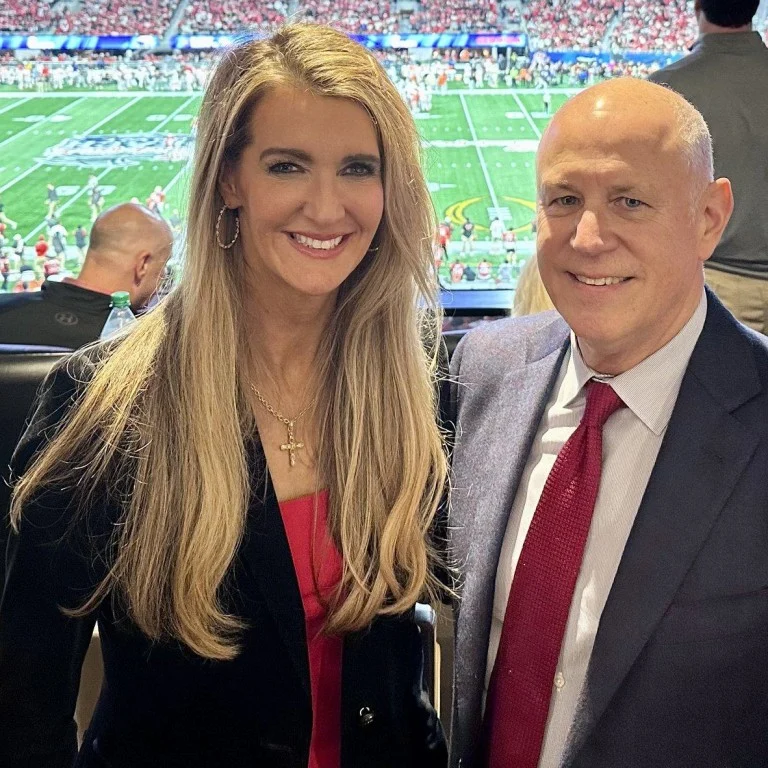

Kelly Loeffler’s public life has never fit neatly into a single category. She has moved from corporate finance and financial technology into professional basketball ownership, then into the U.S. Senate and, most recently, the leadership of the Small Business Administration. That trajectory reflects more than personal ambition; it mirrors a broader American fascination with the movement of business leaders into political power. Today, as SBA administrator, Loeffler occupies a position where entrepreneurship, economic policy, conservative politics, and the changing relationship between government and Main Street converge.
A Career Built Before Washington
Long before national politics, Loeffler developed a career in finance and technology. Raised in rural Illinois, she worked on her family’s farm and small trucking business before becoming the first in her family to graduate from college. She earned a bachelor’s degree from the University of Illinois and later an MBA from DePaul University. Subsequently, her professional path took her through Citibank, William Blair & Company, and other financial-sector positions before she joined Intercontinental Exchange. There, she became part of an executive team involved in the company’s extraordinary expansion, giving her substantial private-sector experience before entering government.
The Executive Who Saw Finance as a Platform
Loeffler’s corporate career became particularly significant through her work at Intercontinental Exchange, the company associated with the New York Stock Exchange. According to her official biography, she held senior responsibilities involving investor relations, communications, and marketing while participating in more than a dozen transactions. In 2018, she became the founding CEO and first employee of Bakkt, a fintech venture designed to provide institutional infrastructure for digital assets. Consequently, her résumé offered a distinctly modern combination of traditional finance, technology, communications, and entrepreneurship when she entered national politics.
Kelly Loeffler and the Atlanta Dream
Her experience was not confined to boardrooms. Loeffler became an investor and later co-owner of the Atlanta Dream, bringing her into the world of professional women’s basketball. That role eventually became politically consequential because the WNBA became increasingly vocal about racial justice and social issues during 2020. Loeffler publicly criticized the league’s embrace of Black Lives Matter messaging, while players and supporters pushed in the opposite direction. The dispute demonstrated how modern sports franchises can become cultural institutions where business ownership, athlete activism, politics, and identity collide. In 2021, she sold her stake in the team.
From Appointment to the U.S. Senate
Loeffler’s arrival in Washington was unusually rapid. After Georgia Senator Johnny Isakson announced his resignation, Governor Brian Kemp appointed her to fill the vacancy, and she was sworn into the Senate in January 2020. Her tenure lasted only about a year, but it placed her at the center of an exceptionally turbulent period in American politics. She presented herself as a strongly conservative Republican and aligned herself closely with Donald Trump. However, her appointment also generated intra-party competition, as Representative Doug Collins challenged her in the 2020 special election.
The Election That Reshaped Her Political Identity
The 2020 Georgia Senate contest became one of the most consequential political races in recent American history. Because no candidate initially secured a majority, Loeffler advanced to a runoff against Democrat Raphael Warnock. She campaigned aggressively as a conservative ally of Trump, while Democrats framed the race as a choice about Georgia’s political future. Warnock ultimately won the runoff, ending Loeffler’s brief Senate career. Nevertheless, the defeat did not remove her from public life. Instead, it encouraged a transition toward political advocacy, entrepreneurship, and conservative organizing outside elected office.
A New Chapter Beyond the Senate
After leaving Capitol Hill, Loeffler remained active in conservative political circles. She founded Greater Georgia Action, an organization focused on election integrity advocacy and voter outreach, and later founded RallyRight, a conservative technology company. These ventures illustrated a recurring feature of her career: when one institutional role ended, she tended to build another platform rather than retreat from public life. Therefore, her post-Senate years can be understood as a bridge between electoral politics and the broader conservative political ecosystem that increasingly relies on advocacy organizations, technology, fundraising networks, and private-sector influence.
Kelly Loeffler at the Small Business Administration
The most important transformation in her career came in 2025, when Loeffler became the 28th administrator of the U.S. Small Business Administration. The position brought her back into government, but this time with responsibility for an agency whose constituency is fundamentally entrepreneurial. The SBA supports Americans seeking to start and grow businesses, making its leadership especially relevant to debates over credit, regulation, disaster assistance, government contracting, innovation, and economic opportunity. Her appointment therefore brought her career full circle: the former finance executive was now responsible for an agency designed to help entrepreneurs navigate the American economy.
| Role | What it reveals about her career |
|---|---|
| Intercontinental Exchange executive | Deep experience in finance, communications, and corporate growth |
| Bakkt founding CEO | Exposure to fintech and emerging digital-asset markets |
| Atlanta Dream owner | Intersection of business, sports, culture, and politics |
| U.S. Senator from Georgia | Entry into national electoral politics |
| SBA Administrator | Return to government through economic and small-business policy |
The Small-Business Message
The central theme of Loeffler’s current public role is economic opportunity. Under her leadership, the SBA has emphasized access to capital, deregulation, domestic production, and entrepreneurship. During National Small Business Week in 2026, she joined President Trump at the White House to celebrate entrepreneurs and small manufacturers, describing small businesses as central to the American economic story. Meanwhile, she has argued for expanding the maximum size of certain SBA-backed loans, reflecting her belief that entrepreneurs sometimes need substantially more capital to scale.
Technology, AI, and the Next Main Street
Interestingly, Loeffler’s technology background also shapes how she discusses the future of small business. In 2026, she argued that artificial intelligence could become a major source of opportunity for Main Street enterprises, suggesting that smaller companies may benefit from technologies that were once accessible primarily to large corporations. That perspective connects her earlier career in financial technology with her present responsibilities. Rather than treating entrepreneurship as something static, she increasingly presents it as an arena being transformed by automation, digital tools, capital markets, and changing consumer expectations.
The Contradictions That Make Her Story Significant
Loeffler’s career also reveals the contradictions of contemporary American power. She is simultaneously a business executive, political conservative, former senator, sports-world figure, and federal administrator. Her supporters see those experiences as evidence that private-sector expertise can improve government; critics have questioned how closely business interests and political influence should intersect. Either way, her biography illustrates how increasingly porous the boundaries have become between corporate leadership and public service. Her story is therefore not simply about one politician but about a broader American debate over who should govern economic institutions.
A Political Career Still in Motion
Although her Senate tenure was brief, Loeffler’s trajectory demonstrates that political influence does not necessarily depend on winning repeated elections. Her current position gives her a national platform while placing her at the center of policy discussions affecting millions of entrepreneurs and small businesses. Moreover, her continued alignment with the Trump administration places her within a political movement that emphasizes deregulation, domestic production, private enterprise, and what it calls an America First economic agenda. Her influence now depends less on campaign votes and more on administrative decisions and policy implementation.
Why Kelly Loeffler Remains a Figure Worth Watching
What makes Loeffler particularly interesting is the unusual continuity running beneath seemingly different careers. Finance taught her how capital moves. Technology exposed her to disruption. Sports showed her how business can become entangled with culture. Politics placed her inside America’s most polarized institutions. Now, the SBA gives her responsibility for translating economic philosophy into government policy. Consequently, her career offers a useful lens through which to examine modern conservative leadership: increasingly corporate in background, highly political in presentation, and deeply focused on entrepreneurship as both an economic engine and a cultural ideal.
Conclusion: Business, Politics, and the American Entrepreneurial Story
Kelly Loeffler’s journey from an Illinois upbringing to Wall Street, professional basketball, the Senate, and the Small Business Administration is ultimately a story about reinvention. Each stage has added another dimension to her public identity, while her current role places economic opportunity at the center of her work. Whether one views her approach as an effective fusion of business expertise and public service or as an example of the growing overlap between wealth, politics, and institutional power, her career remains significant. Ultimately, Loeffler represents a distinctly contemporary kind of American public figure—one whose influence crosses the boundaries of business, politics, technology, sports, and culture.