Introduction
Pergo vs SmartCore is more than a comparison between two flooring names. It reflects a broader question facing homeowners today: how can a floor look refined, survive everyday life, and still make financial sense? Both brands have become recognizable in the world of resilient flooring, yet they approach that promise differently. Pergo brings a long-established reputation for laminate and flooring innovation, while SmartCore has become closely associated with waterproof luxury vinyl plank flooring. Consequently, choosing between them requires looking beyond color and appearance toward construction, maintenance, comfort, installation, and the realities of the room where the floor will live.
Pergo’s Long History of Reinventing the Floor
Pergo occupies an unusual place in flooring culture because its name is closely linked with the development and popularization of modern laminate flooring. For many homeowners, laminate represented a turning point: the appearance of wood became more accessible without requiring the cost and maintenance associated with traditional hardwood. Over time, Pergo expanded its approach, offering products designed for increasingly demanding household environments. Therefore, its appeal is not simply visual. It is rooted in the idea that a practical floor can still contribute substantially to the character of a home.
Why SmartCore Appeals to Today’s Homeowners
SmartCore represents a different chapter in flooring design. Its products are primarily associated with luxury vinyl plank, a category that has grown rapidly because homeowners want realistic wood appearances alongside resistance to moisture and everyday wear. Unlike traditional flooring choices that can feel tied to a particular era, SmartCore speaks directly to contemporary concerns: busy kitchens, pets, children, renovations, and spaces where water exposure is possible. As a result, SmartCore often enters the conversation when practicality is just as important as visual style.
Pergo vs SmartCore: The Construction Question
The most important distinction in Pergo vs SmartCore is the material itself. Pergo offers laminate lines as well as other flooring products, meaning its performance varies by collection. Laminate generally uses a wood-based core beneath a decorative surface and protective wear layer. SmartCore, by contrast, uses rigid-core luxury vinyl construction in many of its products. That difference affects how each flooring type responds to moisture, impact, temperature changes, and installation conditions. In other words, the brand name matters, but the specific product construction matters even more.
Water Resistance Changes the Conversation
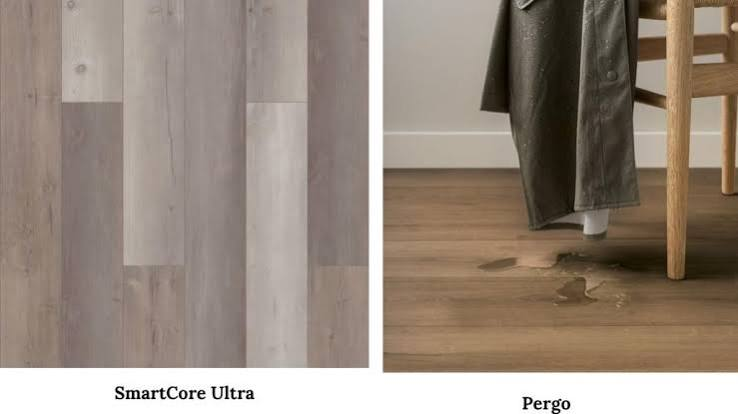
For households where spills are routine, water performance can become the deciding factor. Modern laminate has made considerable progress in moisture resistance, with some products specifically engineered for improved protection. However, vinyl flooring is generally associated with stronger moisture-oriented performance, making SmartCore particularly attractive for bathrooms, kitchens, laundry areas, and lower levels where dampness is a concern.
That does not mean every SmartCore installation is automatically waterproof in every circumstance. Installation quality, seams, subfloor conditions, and the manufacturer’s specifications still matter. Nevertheless, the difference helps explain why homeowners frequently place SmartCore on the shortlist when water exposure is central to their decision.
Appearance Still Matters More Than We Admit
A floor occupies an enormous visual area, so technical specifications cannot entirely determine whether it feels right in a home. Pergo has spent decades developing wood-inspired patterns, textures, and finishes that aim to make laminate appear convincing from across the room. SmartCore likewise offers designs intended to reproduce the character of hardwood.
However, realism is subjective. Some people appreciate the crisp consistency of contemporary vinyl planks, while others prefer the texture and visual depth associated with premium laminate. Ultimately, the best-looking floor is often the one that works with the home’s architecture rather than simply following the latest decorating trend.
Durability Meets Real Household Life
A flooring sample can look perfect under showroom lighting. Real life is considerably less forgiving. Shoes track in grit, chairs move across surfaces, toys fall, pets run through rooms, and furniture occasionally leaves marks. Therefore, durability should be considered as a daily experience rather than a single specification.
Both Pergo and SmartCore offer products designed for residential wear, but their performance depends heavily on the individual collection, wear layer, installation, and maintenance. A homeowner comparing Pergo vs SmartCore should therefore examine the precise product specifications rather than assuming that every floor carrying the same brand name performs identically.
Installation: The Part Homeowners Often Underestimate
Flooring installation can transform a seemingly simple renovation into a demanding project. Many contemporary Pergo and SmartCore products use floating or click-lock installation systems, which can make them attractive to experienced DIY renovators. Nevertheless, preparation remains crucial.
The subfloor must be appropriately clean, stable, and level, while expansion requirements and manufacturer instructions need to be followed carefully. Moreover, mistakes made during installation can affect the appearance and long-term performance of even an excellent product. Consequently, the question is not simply which floor is easier to install, but which installation method best matches the homeowner’s confidence and circumstances.
Comfort, Sound, and the Feeling Beneath Your Feet
Flooring is also a sensory experience. The difference between stepping onto one surface and another can be surprisingly noticeable. Vinyl plank may provide a somewhat softer, resilient sensation underfoot, while laminate can deliver a firmer response that some homeowners associate with wood-like flooring.
Sound is another consideration. Floating floors can produce different acoustic qualities depending on the room and subfloor. Underlayment, installation technique, room furnishings, and ceiling height can all influence the final result. Thus, a flooring decision should ideally consider not only what the floor looks like in a photograph but also how it will feel and sound during an ordinary day.
A Practical Pergo vs SmartCore Comparison
| Consideration | Pergo | SmartCore |
|---|---|---|
| Common material | Laminate and other flooring types | Rigid-core luxury vinyl plank |
| Moisture focus | Varies by collection | Generally a major strength |
| Wood appearance | Strong range of wood-inspired designs | Strong range of wood-inspired designs |
| DIY potential | Often suitable for floating installation | Often suitable for click-lock installation |
| Maintenance | Generally straightforward | Generally straightforward |
| Best suited to | Living spaces and homeowners seeking laminate characteristics | Moisture-prone or high-traffic residential spaces |
| Key consideration | Product-specific moisture and wear ratings | Product-specific construction and installation requirements |
The Economics Behind the Decision
Price is rarely just the amount printed on a flooring box. Homeowners also have to consider underlayment, transitions, tools, installation labor, subfloor preparation, removal of existing flooring, and future maintenance. Therefore, the apparently cheaper option can sometimes become more expensive once the complete project is calculated.
Pergo and SmartCore both occupy broad product ranges, so there is no universal winner on cost. Instead, the smarter approach is to compare equivalent products based on thickness, wear protection, warranty, installation requirements, and intended room. A lower price is valuable only when the flooring still meets the demands of the household.
Which Floor Makes More Sense for a Busy Home?
The answer depends on what “busy” means. A family with children and pets may prioritize scratch resistance, easy cleaning, and durability. Someone renovating a kitchen or laundry room may place moisture performance at the top of the list. Meanwhile, a homeowner updating a bedroom or living room may care more about appearance, warmth, and the character of the surface.
This is why Pergo vs SmartCore does not produce one universal winner. The better floor is the one whose strengths correspond to the room’s actual challenges.
A Conversation About Modern Flooring Choices
Imagine a Saturday afternoon in a suburban home: flooring samples are spread across a kitchen counter, furniture has been pushed toward the walls, and the homeowner is trying to imagine how a small plank sample will look across hundreds of square feet. The decision may seem technical, yet it is deeply personal.
A floor becomes part of family routines. It is where children play, where pets sleep, where guests gather, and where ordinary mornings begin. Consequently, choosing flooring is partly an exercise in imagining the future. The most useful comparison is therefore not simply Pergo vs SmartCore on paper, but which material supports the life expected to happen above it.
The Better Choice Depends on the Room
For moisture-sensitive areas, SmartCore’s rigid-core vinyl construction can make it particularly compelling. For homeowners who value laminate’s established aesthetic and surface characteristics, Pergo can remain an attractive choice. Yet even within those categories, product lines differ substantially.
Before buying, homeowners should check the manufacturer’s specifications for water resistance, wear rating, installation requirements, warranty conditions, and recommended applications. Additionally, ordering samples can reveal differences in color and texture that photographs often conceal.
FAQs
Is SmartCore better than Pergo?
Not universally. SmartCore may have an advantage where moisture resistance is especially important, while Pergo may appeal to homeowners who prefer particular laminate styles and characteristics.
Is Pergo waterproof?
Some Pergo products are engineered with enhanced water resistance, but performance varies by collection. Homeowners should check the specifications of the exact product rather than applying one description to the entire brand.
Which is easier to maintain?
Both can be relatively easy to maintain when properly installed and cared for. Regular sweeping or vacuuming and appropriate cleaning methods help preserve the surface.
Which is better for pets?
Both brands offer products suitable for households with pets, but the precise wear layer, texture, warranty, and moisture characteristics should be examined before choosing a specific floor.
Conclusion
Pergo vs SmartCore ultimately reveals how much flooring has changed. The modern homeowner is no longer choosing only between carpet, hardwood, and basic tile. Instead, there is an expansive landscape of engineered materials designed to balance beauty, durability, convenience, and cost.
Pergo carries the legacy of laminate’s transformation of residential interiors, while SmartCore reflects the growing demand for resilient vinyl flooring capable of handling modern household pressures. Neither automatically wins the comparison. Instead, the strongest choice emerges when homeowners match the material to the room, the household, and the life they expect to live there.
After all, flooring is not merely a surface beneath our feet. It is part of the backdrop of everyday life—and the best choice is the one that quietly performs its job while making the home feel unmistakably like home.