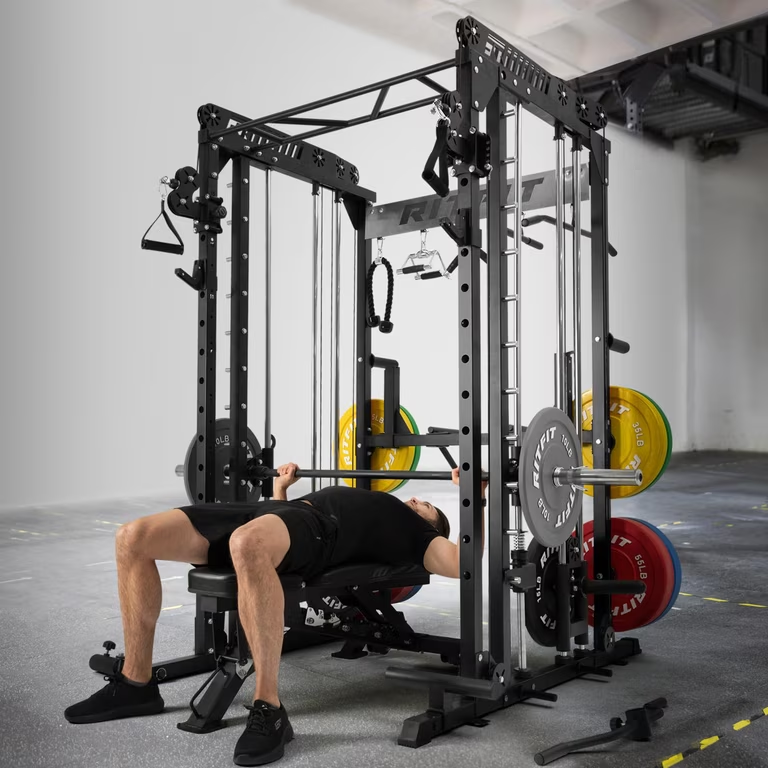
RitFit Smith Machine has become part of a broader change in how people imagine strength training at home. Once associated mainly with commercial gyms, guided-bar systems are increasingly being redesigned for garages, spare rooms, and compact workout spaces. RitFit’s machines combine the Smith mechanism with elements such as power racks, cable systems, pull-up stations, and storage, depending on the model. That combination reflects a larger cultural shift: home fitness is no longer simply about convenience. Increasingly, people want a training environment that feels purposeful, adaptable, and capable of growing with them.
Why the RitFit Smith Machine Fits the Modern Home Gym
The appeal begins with consolidation. Instead of filling a room with separate stations, a multifunctional Smith system can bring several forms of resistance training into one structural footprint. RitFit’s M1, for example, combines a Smith attachment, power rack, cable crossover, pull-up functionality, and storage features. Meanwhile, newer models such as the M2 expand the concept with modular configurations and, in some versions, three-dimensional Smith movement. Consequently, the machine speaks to people who want variety without turning their homes into miniature commercial gyms.
From Garage Equipment to a Personal Training Environment
There is something cultural about the rise of the serious home gym. A decade ago, a few adjustable dumbbells and a bench could represent a complete domestic setup. Today, dedicated lifters increasingly think about lighting, flooring, storage, mirrors, sound, and equipment layout as part of an intentional training space. The RitFit Smith Machine fits neatly into that evolution. Rather than being treated as an isolated piece of equipment, it can become the visual and functional center of a room, giving the space an identity built around consistency, discipline, and personal progress.
What Makes a Guided Bar Useful?
The Smith system offers something free-weight training cannot provide in exactly the same way: a guided bar path. The bar travels along a fixed mechanism, allowing users to concentrate on movement, positioning, and muscular effort without managing the same degree of balance required by a completely free barbell. That does not make guided training universally better. Instead, it makes it different. For solo lifters, beginners learning movement patterns, or experienced users pursuing controlled repetitions, that distinction can be particularly valuable. RitFit’s M1 uses a linear-bearing design and selectable bar positions as part of this approach.
The All-in-One Philosophy Behind the Design
The strongest argument for a multifunctional system is versatility. A single frame can support squats, presses, pull-ups, rows, cable movements, landmine exercises, and accessory work. As a result, the user can move between strength, hypertrophy, and functional exercises without repeatedly rebuilding the workout space. Reviews of the M1 have highlighted its combination of rack, Smith, cable, and bodyweight capabilities, while the newer M2 family emphasizes modular configurations for different training preferences. This reflects an important principle of contemporary home fitness: equipment earns its place by doing more.
A Machine Designed Around Space, Not Just Strength
Space is one of the quietest influences on home-fitness purchasing decisions. A garage may have enough room for one major station, but not several specialized machines. Likewise, a spare bedroom can accommodate a substantial rack while still needing to function as a living space. RitFit has responded to that reality with compact multifunctional designs. The M1, for example, has been presented as a roughly 21-square-foot-class system, while the M3 combines three major training stations within a 21.5-square-foot footprint. Therefore, the value is not merely measured in weight capacity; it is also measured in how efficiently a machine occupies a room.
Where the Cable System Changes the Experience
Cable training introduces another dimension to the home workout. Unlike a barbell, which encourages primarily bilateral and compound patterns, adjustable cables can be positioned for movements such as flyes, rows, curls, triceps extensions, raises, and face pulls. That flexibility makes transitions between exercises remarkably practical. Some RitFit systems use dual adjustable pulley arrangements, while the M3 incorporates a 16-pulley crossover system with multiple adjustment positions. In everyday terms, this means the machine can support both the large movements that build strength and the smaller exercises that shape a complete session.
The Human Side of Training Alone
The most interesting story may not be mechanical at all. Training at home changes the social atmosphere of exercise. There is no crowd, no waiting for a bench, and no pressure to match another person’s pace. Instead, the lifter develops a private rhythm: the same corner of the garage, the same music, the same sequence of warm-up sets. A multifunctional machine can reinforce that ritual because it reduces the friction between deciding to train and actually beginning. For busy parents, professionals, or people who simply prefer privacy, that psychological convenience can matter as much as technical specifications.
Strength, Safety, and the Importance of Setup
A sophisticated home machine still requires responsible use. Guided movement can provide useful control, but it does not remove the need for correct technique, appropriate loading, adequate clearance, and careful assembly. Reviews of RitFit systems have noted that assembly can be substantial, with some users spending several hours completing installation. That matters because a large rack is not furniture that can simply be placed wherever convenient. Its stability, cable routing, bar alignment, and surrounding floor space all influence the training experience. A serious home gym begins wit
h installation as much as equipment selection.
Choosing Between Models and Configurations
RitFit’s range illustrates how quickly the all-in-one category is developing. The M1 emphasizes a multifunctional rack-and-cable concept, while the M2 offers several configurations, including versions with 3D Smith movement and weight stacks. The M3 pushes the platform further with a larger 3-by-3-inch, 11-gauge frame, integrated cable crossover, built-in stacks, storage, and a Smith system. Consequently, buyers should resist choosing solely by appearance or headline capacity. The better question is simpler: which combination of movements, resistance systems, dimensions, and features actually matches the way the owner intends to train?
| Model | Standout idea | Best suited to |
|---|---|---|
| M1 | Smith, rack and cable crossover combination | Versatile home strength training |
| M2 | Modular configurations and optional 3D movement | Users wanting customization |
| M3 | Larger frame, cable system and integrated stacks | More demanding all-in-one setups |
The Investment Beyond the Price Tag
A home gym purchase is rarely just about the initial price. There are also floors, benches, plates, attachments, assembly time, ceiling height, and available training space to consider. However, multifunctional equipment can change the calculation by replacing several individual stations. The M3, for instance, integrates a power rack, cable crossover, Smith machine, storage, and weight stacks into one platform. Therefore, its value can be better understood through the number of training possibilities it creates rather than through the machine’s price in isolation.
When an All-in-One System Makes Sense
An integrated strength station is particularly compelling for someone who already knows they enjoy resistance training and wants to make it a permanent part of everyday life. It is less compelling for someone who prefers running, bodyweight training, or minimalist equipment. Similarly, people with very low ceilings or limited floor clearance should measure carefully before committing. The point is not that every lifter needs a multifunctional machine. Rather, its appeal grows when consistency, exercise variety, and space efficiency are all important priorities.
The New Meaning of the Home Gym
The rise of machines such as these says something broader about contemporary fitness culture. Exercise is increasingly moving away from the idea of a separate destination and becoming part of domestic life. The home gym can be a place of solitude after work, a weekend project shared by family members, or a long-term investment in physical capability. In that context, the RitFit Smith Machine represents more than guided resistance training. It represents the ambition to make strength accessible without requiring a commercial gym membership, crowded floor, or rigid schedule.
Conclusion: Building a Routine, Not Just a Rack
Ultimately, equipment can create possibilities, but routine creates results. The attraction of the RitFit Smith Machine lies in its ability to make a broad range of strength exercises available within one organized environment. Its combination of guided lifting, cable work, rack training, and accessories reflects where home fitness is heading: toward spaces that are compact, versatile, and deliberately personal. Yet the real measure of any machine remains what happens after the assembly is finished. When the novelty fades and the same bar is loaded week after week, equipment becomes something more meaningful—a physical setting for discipline, progress, and the quiet habit of showing up.