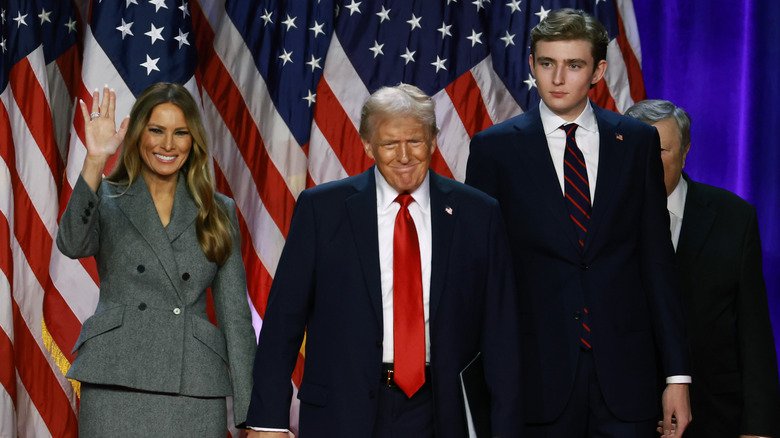

barron trump height disease is a search phrase that reflects a surprisingly modern kind of curiosity: when a famous person’s appearance becomes the starting point for questions about their health. Barron Trump, the youngest son of Donald and Melania Trump, has attracted sustained attention because of his exceptional height. Yet the public record does not establish that he has a height-related disease. Instead, the story reveals how quickly an ordinary physical characteristic can become medical speculation when photographs, celebrity culture, and social media collide.
Why Barron Trump’s Height Became a Public Fascination
Barron Trump’s height became increasingly noticeable as he grew from a child into a young adult. Public appearances repeatedly showed him towering over his parents and other adults, turning his stature into a recurring feature of entertainment and political coverage. Reports have commonly placed him around 6 feet 7 inches, while some online estimates have gone higher. E! News, for example, reported that the Palm Beach Post had him at 6-foot-7 and noted that internet speculation had placed him as high as 6-foot-9.
That visual contrast is powerful. Photography encourages comparison, and Barron is often photographed beside Donald Trump and Melania Trump, making his height immediately apparent. Moreover, Donald Trump himself has spoken publicly about his son’s stature, including joking about whether basketball might suit him because of his height. Those comments helped turn a family trait into a recurring media subject. However, none of these observations amount to a medical diagnosis.
What the Public Record Actually Says
The most important distinction is between what is documented and what is merely assumed. Barron Trump is widely reported to be exceptionally tall, but there is no credible public confirmation that he has a disease responsible for that height. Neither photographs nor repeated internet claims can establish a medical condition. In fact, responsible reporting about his height generally treats it as an unusual physical characteristic rather than evidence of illness. PEOPLE has likewise described him as approximately 6-foot-7 while emphasizing his relatively private upbringing.
This matters because health information is fundamentally different from celebrity trivia. A person’s height can be observed, estimated, and discussed. A diagnosis, by contrast, requires medical evaluation. Therefore, the phrase barron trump height disease should not be interpreted as the name of an established condition. It is better understood as an internet search question generated by public curiosity.
| Publicly discussed fact | What it does—and does not—establish |
|---|---|
| Barron Trump is exceptionally tall | It establishes that his stature is unusual, not that he is ill |
| Reports commonly place him around 6’7″ | A reported height is not a medical diagnosis |
| His parents are also relatively tall | Genetics can contribute substantially to height |
| Online users speculate about conditions | Online speculation is not clinical evidence |
| No confirmed height-related diagnosis is publicly documented | The absence of a public diagnosis should not be converted into a claim about private medical records |
Could Extreme Height Ever Be Connected to a Medical Condition?
The medical question behind the search is legitimate, even if applying it to a particular person without evidence is not. Height is influenced heavily by genetics. MedlinePlus Genetics notes that scientists estimate roughly 80 percent of an individual’s height is associated with inherited DNA variation, although nutrition and other environmental influences also contribute. Consequently, being exceptionally tall does not automatically indicate a disorder.
There are, nevertheless, medical conditions in which unusual height can be part of a broader pattern. Marfan syndrome, for example, is a connective-tissue disorder that can involve tall stature, long limbs, flexible joints, eye problems, and cardiovascular complications. Importantly, however, height alone cannot diagnose Marfan syndrome. Medical professionals consider physical findings, personal and family history, and appropriate testing. The National Heart, Lung, and Blood Institute explains that diagnosis involves clinical evaluation and may include imaging, eye examinations, and genetic testing.
Why Marfan Syndrome Often Enters the Conversation
Marfan syndrome is frequently mentioned in internet discussions about unusually tall people because one recognizable feature can be a tall, slender body with elongated limbs and fingers. Yet that association can be misleading when removed from its medical context. MedlinePlus explains that Marfan syndrome affects connective tissue throughout the body and can involve the heart, blood vessels, eyes, bones, joints, and other systems.
Therefore, seeing a tall person and immediately suggesting Marfan syndrome reverses the proper diagnostic process. Doctors do not work backward from height alone. Instead, they assess a constellation of characteristics and relevant medical findings. In Barron Trump’s case, there is no reliable public evidence establishing such a diagnosis. Consequently, attaching the condition to him simply because of his appearance would be speculation rather than responsible health reporting.
What About Growth Hormone Disorders?
Another reason the search persists is the existence of conditions involving excessive growth hormone. In children, unusually high growth hormone levels can contribute to gigantism, a rare disorder associated with accelerated growth and exceptional height. Mayo Clinic explains that gigantism occurs when excess growth hormone is produced before the growth plates close.
That medical fact, however, should not be mistaken for evidence concerning Barron Trump. Establishing gigantism would require clinical assessment and laboratory testing rather than visual observation. A tall young adult does not automatically have a hormone disorder. Furthermore, ordinary genetic variation can produce substantial differences in height between people, including members of the same family. The existence of a medical explanation for extreme height does not mean that every extremely tall person has that explanation.
The Human Cost of Turning Appearance Into Diagnosis
Behind the search trend is a larger cultural issue: the internet has made visual observation feel almost equivalent to knowledge. A photograph can show that someone is tall, but it cannot show what is happening inside that person’s body. Nevertheless, social media often rewards the most confident explanation rather than the most accurate one.
This is particularly significant with Barron Trump because he spent much of his childhood under extraordinary public scrutiny. His mother, Melania Trump, has repeatedly emphasized privacy around her son, while biographies of the family have noted that his upbringing was comparatively protected from constant political exposure.
The ethical question, therefore, is not whether people are allowed to notice his height. They obviously will. The question is whether noticing should become diagnosing. That is where responsible journalism should draw a clear boundary.
Barron Trump Beyond the Numbers
| Who he is | Public context |
| Barron William Trump | Youngest son of Donald Trump and Melania Trump |
| Born | March 20, 2006 |
| Publicly reported height | Commonly reported around 6’7″ |
| Education | Graduated from Oxbridge Academy in Florida in 2024 |
| Public profile | Generally more private than other members of the Trump family |
| Media attention | Height, family background, and occasional public appearances |
Although his surname guarantees attention, Barron’s public identity has developed differently from that of many political-family children. PEOPLE reported that he graduated from Oxbridge Academy in 2024 and later pursued higher education, while also noting the family’s efforts to maintain aspects of his private life.
His height has consequently become one of the easiest things for the public to discuss because it is visible and seemingly uncomplicated. Yet that simplicity is deceptive. A number on a height chart says very little about someone’s health, personality, ambitions, or future.
The Search Term Says More About the Internet Than the Person
Perhaps the most revealing aspect of barron trump height disease is what the phrase tells us about modern search culture. People increasingly type questions into search engines using compressed language: a name, a physical characteristic, and the word “disease.” The resulting phrase can look authoritative even when it has no medical meaning.
This creates a feedback loop. Someone asks whether a condition exists, another website publishes an article about the question, social media repeats it, and eventually the search itself appears to validate the rumor. In reality, repetition does not transform speculation into evidence. For health-related claims involving public figures, the standard should remain the same: credible documentation, medical evidence, and respect for privacy.
What Readers Should Take Away
The responsible conclusion is straightforward. Barron Trump is exceptionally tall, with credible media reports commonly placing him around 6 feet 7 inches. However, there is no publicly verified evidence establishing a disease or disorder responsible for his height. Claims about Marfan syndrome, gigantism, or other conditions should therefore be treated as unconfirmed speculation rather than fact.
At the same time, the medical background is worth understanding. Some disorders can affect growth, but they involve broader clinical patterns and require professional assessment. Height itself is not a diagnosis.
Conclusion: When Curiosity Needs a Boundary
The fascination surrounding barron trump height disease ultimately reflects a broader tension in celebrity culture. People want explanations for what they see, especially when the subject belongs to one of the world’s most recognizable families. Yet curiosity becomes problematic when appearance is treated as medical evidence.
Barron Trump’s height is a striking and well-documented feature of his public appearances. What remains undocumented is any confirmed disease connected to it. That distinction may seem modest, but it is essential. In an age when rumors can travel faster than facts, the more meaningful story is not finding a dramatic diagnosis where none has been established. It is learning to recognize the difference between something we can see and something we actually know.